


Welcome to a new issue of the Unlocking Real Estate Value newsletter. Each week I will provide you with exclusive advice and professional insights to help you realise long-term value through real estate development.

Controlling costs early is the single biggest lever in development. Here’s how to set up your project for success.
In real estate development, managing project costs is vital, but it shouldn’t come at the expense of your project’s vision. When costs rise, many developers face the tough choice between staying on budget or keeping their original goals. However, with proper planning and control processes, you can manage costs without sacrificing quality or vision.
Below, we will break down five key strategies to help you keep project costs in check while staying true to your vision:
Turn your vision into measurable KPIs.
Write a brief that makes cost expectations clear.
Set up a rigorous cost management process.
Gate every design stage with a formal cost review.
Use value engineering when costs rise.
Now, let’s dive in.
Step 1: Turn Your Vision into Measurable KPIs Before Day One
Before starting the development process, it’s important to translate your project vision into a set of Key Performance Indicators (KPIs). KPIs should be measured and tracked throughout the project to guide your decision-making process.
Getting this step right at the start will help set up a process where it’s much easier to track costs during the design phase.
Here is a selection of typical KPIs that apply to most types of projects:
Nett-to-Gross Ratio
Wall-to-Floor Ratio
Parking Ratio
Plant-to-Gross Area Ratio
Tip: Ensure everyone on the team understands the KPIs and how they tie back to the project’s vision.
Step 2: Write a Brief That Makes Cost Expectations Crystal Clear
A clear and detailed project brief is crucial to ensure that the project scope, objectives, and budget are understood by all stakeholders. A brief aligned with the Development Business Plan will act as a clear roadmap from the outset.
The brief is one of the pillars used to instruct the professional team working on the project. A document that covers the basics will ensure that:
The team knows the client’s priorities.
Time isn’t wasted on designs that won’t get approved.
The product stays focused.
If the development project is meant to be a cost-driven exercise, it helps to have a brief that states this clearly at the beginning.
Tip: Revisit the brief regularly to ensure alignment as the project progresses.
Step 3: Put Your Cost Manager at the Design Table from Day One
A structured cost management system—including regular budget reviews and financial reporting—can provide transparency and prevent cost overruns.
During the high cost inflation experienced in recent years, most development projects have had to apply a Design-to-Cost strategy to progress.
To succeed, you need to tightly integrate cost management into the overall process. The cost manager should be at the table during all design workshops to understand the background behind key decisions. Key project decisions should be made with complete information about costs and how they relate to the overall target budget.
This process will help all stakeholders navigate the project with full awareness, always informed of the impacts of key decisions.
Tip: Implement a cost-tracking system that flags potential issues early, giving you time to make adjustments.
Step 4: Gate Every Design Stage with a Formal Cost Review
Costs should be reviewed regularly. This is important as it allows the client team to be proactive in instructing the team to progress with the design without slowing down the program.
Formal cost reviews should take place at the end of each design stage. These reviews are integral parts of the design stage submission, and the project shouldn’t progress to the next stage if costs are not aligned with the budget. Waiting until the end of the design process to review and manage costs can cause significant issues for the wider team.
It’s also very important to ensure that costs are carefully assessed before submitting a project for Planning Approval. The last thing you need as an investor is for the Business Plan to fail because someone decided to seek approval for a scheme they can’t afford to build.
Tip: Conduct thorough reviews with all key stakeholders at the end of each design stage to ensure the project is still aligned with both budget and vision.
Step 5: Run a Structured Value Engineering Process When Costs Rise
When costs rise significantly, Value Engineering becomes an essential process and a valuable strategy to find cost-saving solutions. The aim is to find solutions that don’t compromise the quality of the project.
For this process to be successful, I believe every stakeholder should be involved, starting with the professional team. The whole design should be examined carefully, and everyone should feel encouraged to propose any possible idea.
The process should run in steps as follows:
Build out a list with as many ideas as possible covering all the discipline areas (Architecture, Structure, Building Service, Facade).
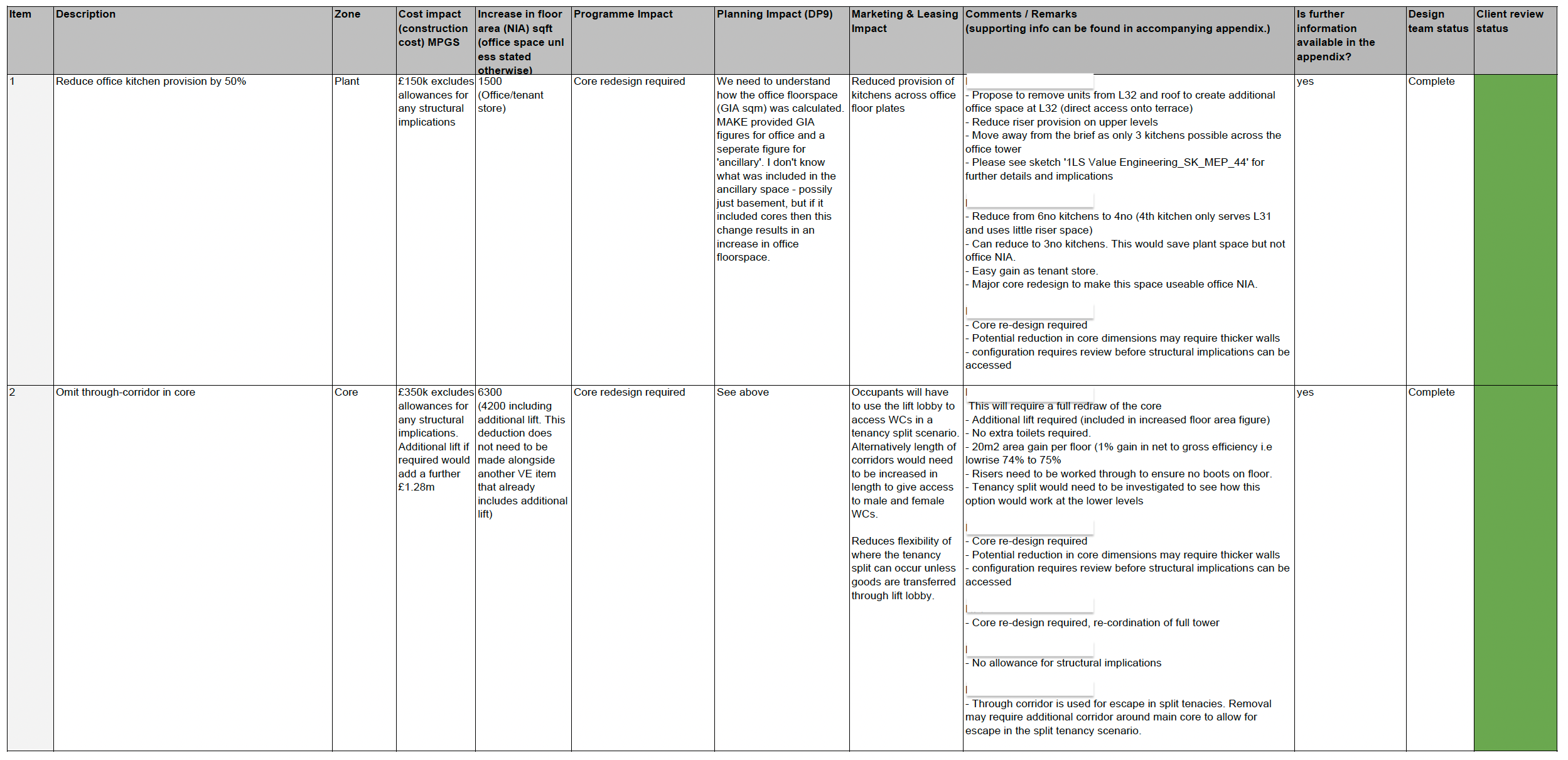
Set up a filter system to evaluate each idea against clear criteria (cost saving amount, impact on planning, impact on programme).
Set up a timeline for the exercise.
Schedule Value Engineering workshops where ideas are discussed.
Accept or Reject ideas.
Wrap up the process and present for final approval.
It’s very important that all ideas are evaluated against these criteria so that informed decisions can be made.
Tip: Involve the whole team in value engineering and score each idea based on cost savings, programme impact, and planning impact to make well-informed decisions.
Conclusion
Managing real estate project costs without compromising vision is possible with a thoughtful approach.
Here are the key takeaways to master cost management in development projects:
Start by aligning KPIs and vision.
Develop a solid project brief.
Integrate cost management from the beginning.
Review costs at every design stage.
When necessary, use value engineering to make smart cuts without sacrificing quality.
By following these steps, you can deliver a project that meets both financial goals and the creative vision that sets it apart.
That’s all for today.
See you next week.
— Carlo
Founder and Managing Director Benigni
Sanity Check Your Project
Before you commit another million to your development, stress-test it with someone who’s delivered 2M sqm and €11B+ GDV across Europe.
Here’s what I can pressure-test for you:
Is your market thesis still valid? Office, hospitality and residential markets are shifting fast. What worked 18 months ago might not work today.
Will your budget survive the current cost environment? Construction costs and programme risk need a reality check before you commit.
Does your ESG strategy attract or repel capital? Tenants and investors have moved past good intentions. They want metrics.
What risks are you not pricing in? Regulatory shifts, planning delays, cost inflation. The ones that kill projects are the ones you didn’t model.
Book a free 15-minute strategy call. One conversation. No commitment. Just clarity on your next move.
Refer a Colleague
PS…If you’re enjoying this newsletter, please consider referring this edition to a friend or a colleague. Sharing valuable insights helps everyone make better investment decisions.
This post is sponsored by Benigni a specialist development manager working with international investors to realise long-term value through optimised development strategies. To learn more click this link to our website.

Subscribe to the Newsletter
A newsletter by Carlo Benigni providing, in less than 4 minutes, exclusive advice, strategies, and resources to help unlock hidden real estate value.
Subscribe for free to receive new posts and support my work.