


Welcome to a new issue of the Unlocking Real Estate Value newsletter. Each week I will provide you with exclusive advice and professional insights to help you realise long-term value through real estate development.
This post is sponsored by Benigni a specialist development manager working with international investors to realise long-term value through optimised development strategies. To learn more click this link to our website.


Most real-estate professionals like me read far fewer newsletters than they think.
If you are like me you probably suffer from an overcrowded inbox, stuffed with newsletters that you never open simply because you are overwhelmed. Meanwhile, the market moves: rates shift, rules tighten, capital rotates, and new asset types emerge.
If you miss the signal, you miss the moment.
Today you don’t need to read everything to stay ahead. You can build an AI analyst that reads your newsletters for you, pulls out the real signals and sends one short, investor-grade briefing to your inbox each morning.
In this piece, I’ll show you three steps to turn your newsletter chaos into a daily edge — plus the exact prompt you can copy to build your own analyst in minutes.
Step 1: Define Your Real-Estate Signal Criteria Before the AI Starts Reading
Most people connect AI to their inbox and hope for the best.
They never explain what a “signal” is. That’s why the output feels flat and generic.
Start by defining what matters for your real-estate decisions:
Rates, rents, yields, and capital flows
Regulation, ESG rules, and zoning changes
Demand shifts across asset classes (Living, Office, Hospitality, Data Centres, etc.)
Construction costs, timelines, and delivery risk
Once you say what matters, the AI knows what to extract — and what to ignore.
A simple setup:
In Gmail, label the newsletters that influence real decisions (“Newsletters” and/or “Real Estate”).
Write a short list of signal rules, such as: “Flag anything that affects pricing, demand, supply, risk, or feasibility.”
Tell the AI to skip generic pieces: motivation threads, broad AI think-pieces, opinion columns with no CRE read-through.
This alone turns a noisy inbox into a focused deal-intelligence feed.
Goal of Step 1:
Turn your AI into a focused researcher, not a casual reader.
Step 2: Build Your Real-Estate Newsletter Analyst
With clear signal criteria, you can now build the analyst.
ChatGPT can connect to Gmail, read only your labelled newsletters and treat each email like a mini research note.
It can:
Track trends in yields, vacancy, rents, and absorption
Flag regulatory and ESG changes that hit your schemes
Highlight construction-cost moves, procurement risks, and delivery issues
Follow capital flows and pricing shifts by sector and geography
Spot early indicators across asset classes
Explain why each signal matters for you, not just what happened
This is the shift from “recaps” to real analysis.
Instead of “construction costs are down,” you get:
“Lower material prices narrow the viability gap for urban-regeneration projects by 80–120 bps.”
That’s the level of insight a junior analyst would give you, only this one works 24/7 and never gets bored of reading.
Goal of Step 2:
Create an always-on analyst who reads everything so you don’t have to.
Step 3: Turn Summaries into Decisions, Not Just Notes
Plain summaries are passive.
They tell you what’s going on, but not what to do next.
Your briefing should push you toward a decision in under five minutes.
Use this simple format:
1. Top Signals (3–5 bullets)
Short, specific, focused on fundamentals.
2. What Changed Since Yesterday
This shows momentum, not noise. Have things improved, worsened, or stayed flat?
3. Why It Matters
Spell out the read-through into underwriting, feasibility, design, operations, or capital strategy.
4. Actions to Consider
Always end with practical, near-term actions, such as:
Update yield or rent assumptions in live models
Add a question for your next broker or lender call
Stress-test construction budgets or timelines
Flag a regulation or CAM change to your ESG or technical team
Re-think timing or risk on a specific deal
When your briefing ends with concrete next steps, newsletters stop being “interesting content” and become a daily decision tool.
Goal of Step 3:
Move from reading → understanding → deciding → acting.
An Example: What a Daily AI Briefing Actually Looks Like
Here’s a real example of the kind of briefing my AI analyst now sends.
This is the standard you can aim for once your workflow is set up.
# In Short

Daily scan complete. I pulled the newest messages (last 7 days) from your “Newsletters” and “Real Estate” labels and filtered for EU/Italy-relevant real-estate trends, asset-class signals, construction/urban-regeneration, and capital/development themes. Ten items made the cut.

**Data collected at 08:37 Europe/Milan**

## Executive Summary

* Italy 2025 outlooks emphasise retrofit/regeneration, selective capital, and hybrid office demand.
* EU macro signals (weak money supply, disinflation risk) point to gentle rate drift and continued price discovery.
* Construction/ops themes: CAM 2025, change-of-use, energy communities, and hotel sustainability rising on feasibility agendas.

---

## Item 1 — **JLL Italia — Principali trend 2025**  |  [Open in Gmail](<https://mail.google.com/mail/u/0/#inbox/FMfcgzGtrBQPQpWZPtFLzZkDLDJHTPMl>)

*Source · Geography · Asset Class · Domain: JLL · Italy · Office/Living · Trend/Development*
**TL;DR:** 2025 Italy CRE: retrofit/regeneration, hybrid office, and tech/sustainability drive performance.
**What’s new:** • Human-capital focus in office • Hybrid space models • Sustainability + tech adoption
**How to use it:** • Prioritise brown-to-green plays • Re-merchandise office floors • Build ESG data room
**Impact on your work:** Pipeline should tilt to refurbishment with measurable ESG deltas.
**Why it matters:** Capital prefers assets with provable operational and carbon improvements.
**Tags:** Trend; Office/Living; Italy

---

## Item 2 — **Costruction/Tax Note — Deducibilità spese capitali (AGE2)**  |  [Open in Gmail](<https://mail.google.com/mail/u/0/#inbox/FMfcgzGtrBPRpxgJtdXlJqsShPHpV9Mx>)

*Constructuring · Italy · Mixed-Use/Dev · Development/Construction*
**TL;DR:** Update on deductibility treatment for development capital expenses and how to avoid deductions being disallowed.
**What’s new:** • AGE2 framing • Common deduction pitfalls • Practical adjustment steps
**How to use it:** • Review cost coding • Align invoices to scopes • Document capex rationale
**Impact on your work:** Clean capex books reduce audit risk and protect modelled IRR.
**Why it matters:** Tax leakage can erase value-engineering gains.
**Tags:** Development/Construction; Urban Regeneration/Mixed-Use; Italy

---

## Item 3 — **INGENIO — Cambio destinazione d’uso + CAM 2025**  |  [Open in Gmail](<https://mail.google.com/mail/u/0/#inbox/FMfcgzGtrBPOfjiNQvTBcKxgSkRSd3cb>)

*INGENIO · Italy · Mixed-Use/Residential/Office · Development/Construction*
**TL;DR:** Practical guide to change-of-use and preview of CAM 2025; ventilation/condensation compliance issues highlighted.
**What’s new:** • Change-of-use checklist • CAM 2025 updates • VMC/humidity compliance
**How to use it:** • Stress-test specs vs CAM • Add HVAC compliance line-item • Early Comune consult
**Impact on your work:** Faster permits, fewer re-designs in PBSA/office-to-living.
**Why it matters:** Regulatory misses are the biggest cause of Italian timeline slippage.
**Tags:** Development/Construction; Urban Regeneration/Mixed-Use; Italy

---

## What to focus on next

* **JLL Italia 2025** — Direct read-through to your Milan/Rome pipeline and investor messaging.
* **INGENIO (Change-of-use + CAM 2025)** — Immediate compliance implications for PBSA and office-to-living conversions.
* **PPP/PNRR update** — Re-paper PPP assumptions on regeneration SPVs before re-approaching lenders.
Subscribe to the Newsletter
A newsletter by Carlo Benigni providing, in less than 4 minutes, exclusive advice, strategies, and resources to help unlock hidden real estate value.
Subscribe for free to receive new posts and support my work.
Step 4: Steal My Prompt — Build Your Own AI Newsletter Analyst
Here is the copy-and-paste prompt you can use to build your own analyst in ChatGPT.
Just follow these steps to setup a recurring task:
Method 1: Drop the prompt in the chat window and simply ask ChatGPT schedule a recurring daily task running the prompt below.
Method 2: Open the Settings > Schedules > Manage
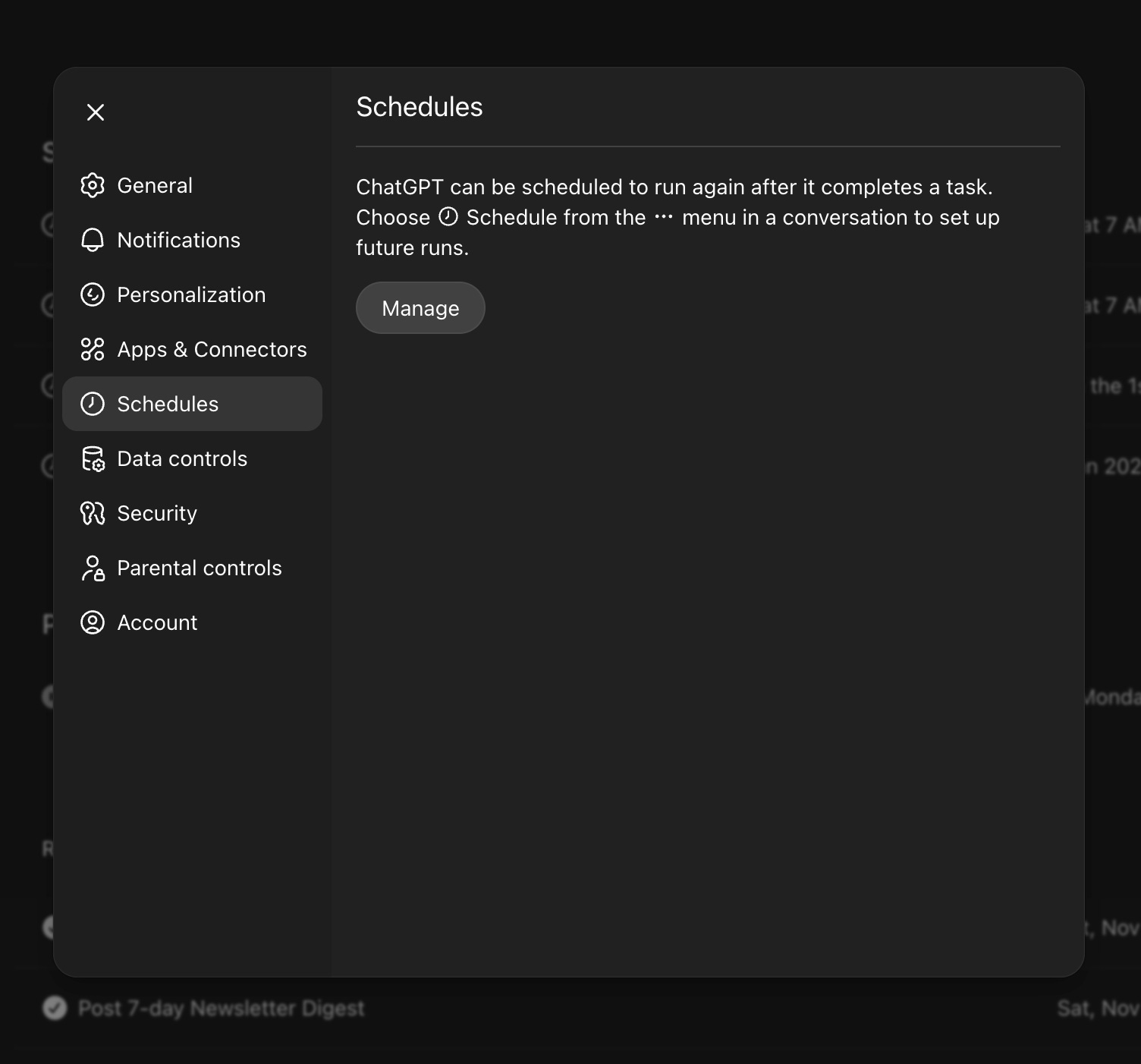
Once you click on Schedules, review your scheduled task and adjust the recurrence to suit. Here you can also manually update the prompt.
