


Welcome to a new issue of the Unlocking Real Estate Value newsletter. Each week I will provide you with exclusive advice and professional insights to help you realise long-term value through real estate development.
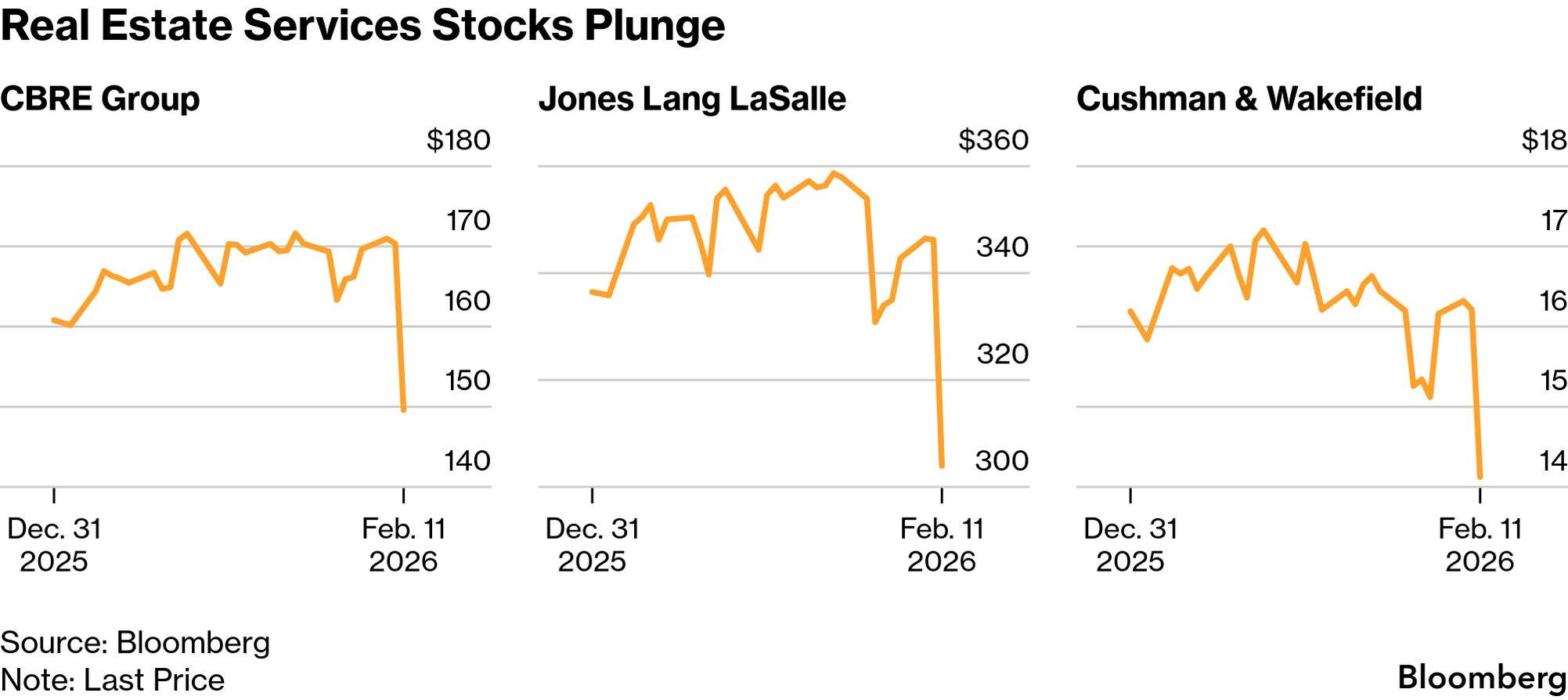
Last week, CBRE lost roughly $12 billion in market value in two days. JLL dropped 14%. Cushman fell 13%. The market called it the “AI scare trade.”
Investors panicked. They think AI is coming for brokerage commissions, office demand and fee-based business models.
I’ve been on the AI train for some time now. I follow the community closely. I see the transformation happening daily. So the news surprised me, but only partially.
Because the market got the diagnosis wrong.
AI won’t replace brokers, developers, or asset managers. But it will change who wins.
Here’s how.
Lesson 1: The threat isn’t AI. It’s a 28-year-old broker who uses it better than you.
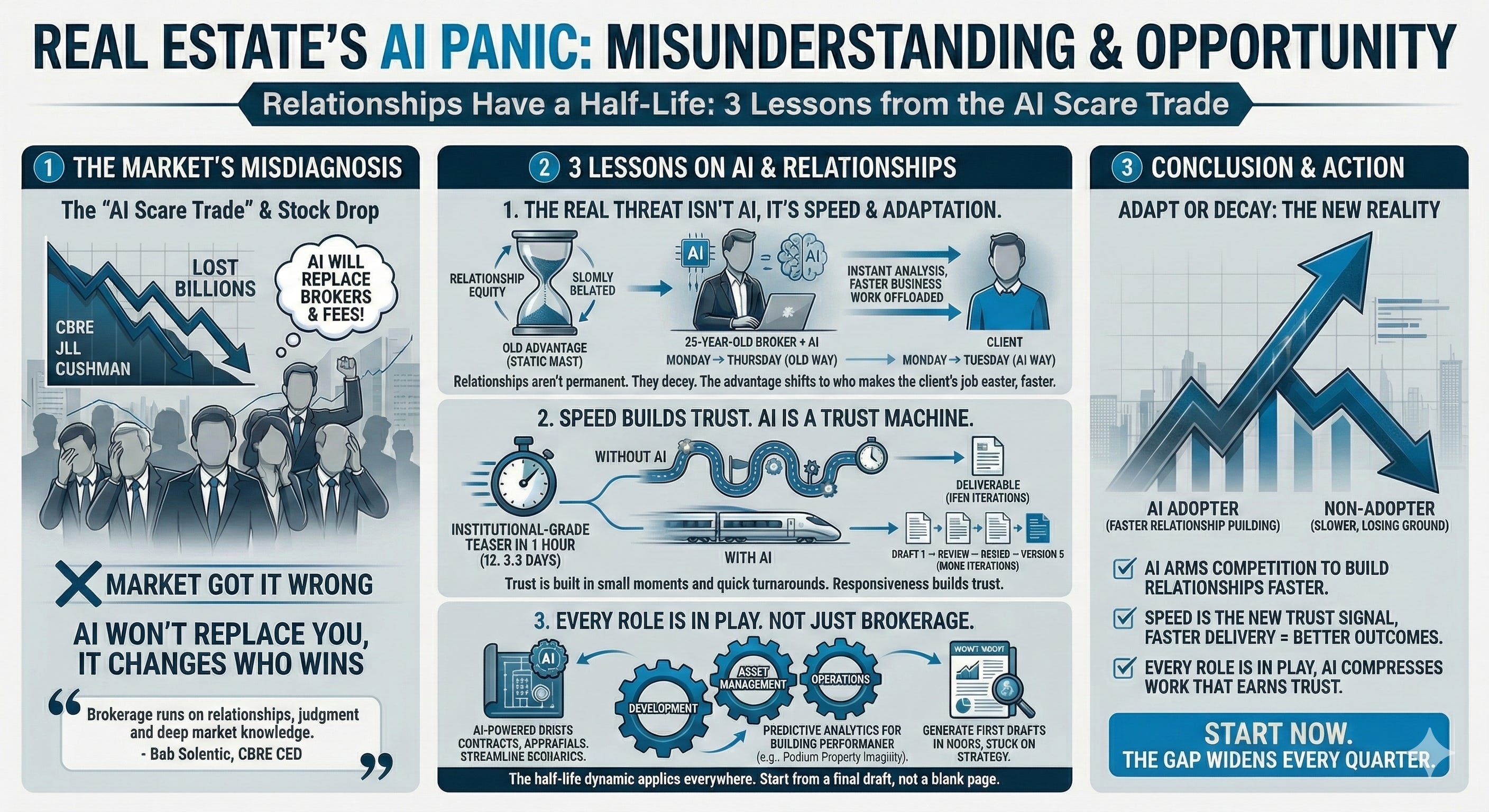
CBRE CEO Bob Sulentic pushed back hard on the earnings call. Brokerage runs on relationships, judgment and deep market knowledge.
He’s right.
But here’s the uncomfortable part. Relationships aren’t permanent. They form and decay all the time.
Picture this. A 28-year-old broker shows up with institutional-grade market analysis generated that morning. Rent comps across every comparable building in 20 minutes. Cash flow models that used to need a junior analyst and three days. They’re offloading work that used to sit on the client’s plate.
The client doesn’t wake up one day and replace you. They just start calling the person who makes their job easier. Small deals first. Then bigger ones. Then you haven’t heard from them in six months.
Your 18 years of relationships are real. But that advantage has a half-life. If the client calls you Monday and gets analysis Thursday. Then calls a younger broker Monday and gets better answers Tuesday, that equity decays.
Not all at once.
A little more every quarter.
The game is shifting. Relationships are no longer a static moat.
They are something you earn with every interaction.
Lesson 2: Speed builds trust. AI is a trust-building machine.
Trust isn’t built in annual reviews or deal closings. It’s built in the small moments. The quick turnaround. The extra analysis nobody asked for. The deck that’s ready before the internal meeting.
I experienced this first-hand. A few weeks ago, I created an institutional-grade investor teaser in under one hour using AI. The source data was a scanned PDF in Italian. I extracted the data, translated it to English and built a professionally branded PowerPoint.
A task that would have taken a junior analyst two to three days. Done before lunch.
Without AI: You promise the client a deliverable by Thursday. You spend two days on data extraction. Another day on formatting. You deliver on time but with no margin for iteration.
With AI: You deliver a first draft by end of day. The client reviews it that evening. You refine it the next morning. By Thursday, you’re on version three, not version one.
When you make someone’s job easier, you’re forming a relationship. Every interaction either builds trust or erodes it. Speed builds trust. Responsiveness builds trust. Making your client’s life easier builds trust.
Lesson 3: This isn’t just about brokerage. Every real estate role is in play.
The CBRE sell-off focused on brokerage fees. But the same dynamic applies across the entire sector.
Development management. Asset management. Operations.
Eric Ries wrote The Lean Startup. The core idea: put out a product, collect data, optimise, repeat. AI makes this possible for buildings.
When I was at Lendlease, the team built Podium Property Insights: an AI-powered platform that used sensor data and predictive analytics to help CRE managers optimise building performance.
In development, the opportunity is just as clear. I’ve spent years creating Development Briefs, Consultant Scopes and Appraisals across dozens of scenarios.
Every one of these tasks is ripe for streamlining. AI lets you start from a final draft rather than a blank page.
The professional who manually builds a market report in five days will lose ground to the one who generates a first draft in five hours and spends the remaining time on insight and strategy.
The same half-life dynamic from Lesson 1 applies to every discipline.
Conclusion
AI doesn’t replace you.
It arms your competition with the ability to build relationships faster than you can maintain yours.
The market’s AI panic wiped billions off real estate stocks last week.
But the real shift isn’t about robots replacing brokers.
It’s about who adapts fastest.
Relationships have a half-life. You earn them with every interaction, not once at closing.
Speed is the new trust signal. Faster delivery means more iterations, better outcomes, stronger bonds.
Every role is in play. Brokerage, development, asset management: AI compresses the work that earns client trust.
Start now. The gap between AI adopters and non-adopters widens every quarter.
That’s all for today.
See you next week.
— Carlo
Founder and Managing Director Benigni
Sanity Check Your Project
Before you commit another million to your development, stress-test it with someone who’s delivered 2M sqm and €11B+ GDV across Europe.
Here’s what I can pressure-test for you:
Is your market thesis still valid? Office, hospitality and residential markets are shifting fast. What worked 18 months ago might not work today.
Will your budget survive the current cost environment? Construction costs and programme risk need a reality check before you commit.
Does your ESG strategy attract or repel capital? Tenants and investors have moved past good intentions. They want metrics.
What risks are you not pricing in? Regulatory shifts, planning delays, cost inflation. The ones that kill projects are the ones you didn’t model.
Book a free 15-minute strategy call. One conversation. No commitment. Just clarity on your next move.
This post is sponsored by Benigni a specialist development manager working with international investors to realise long-term value through optimised development strategies. To learn more click this link to our website.

Refer a Colleague
PS…If you’re enjoying this newsletter, please consider referring this edition to a friend or a colleague. Sharing valuable insights helps everyone make better investment decisions.
the market priced in disruption before reading the fine print on what ai actually replaces vs what it demands more of