


Welcome back to Unlocking Real Estate Value.
It has been a while since my last issue. I’m pleased to return with an examination of why Italy’s next real estate cycle may be defined less by asset class and more by what a building can become.

Most Italian investment committees still open with the same question: which sector?
Offices or living. Hospitality or logistics. Student or senior.
My view is that this is the wrong first question. The assets that will reprice fastest in Italy over the next three years are not defined by what they are. They are defined by what they can legally and economically become.
Call it convertibility: the measurable ease with which a standing building can change use. Here are 5 reasons it belongs at the top of your screening model, above asset class.
Let’s dive in.
Reason 1: The capital has already arrived. The conversion capacity has not.
Italy is no longer a liquidity problem.
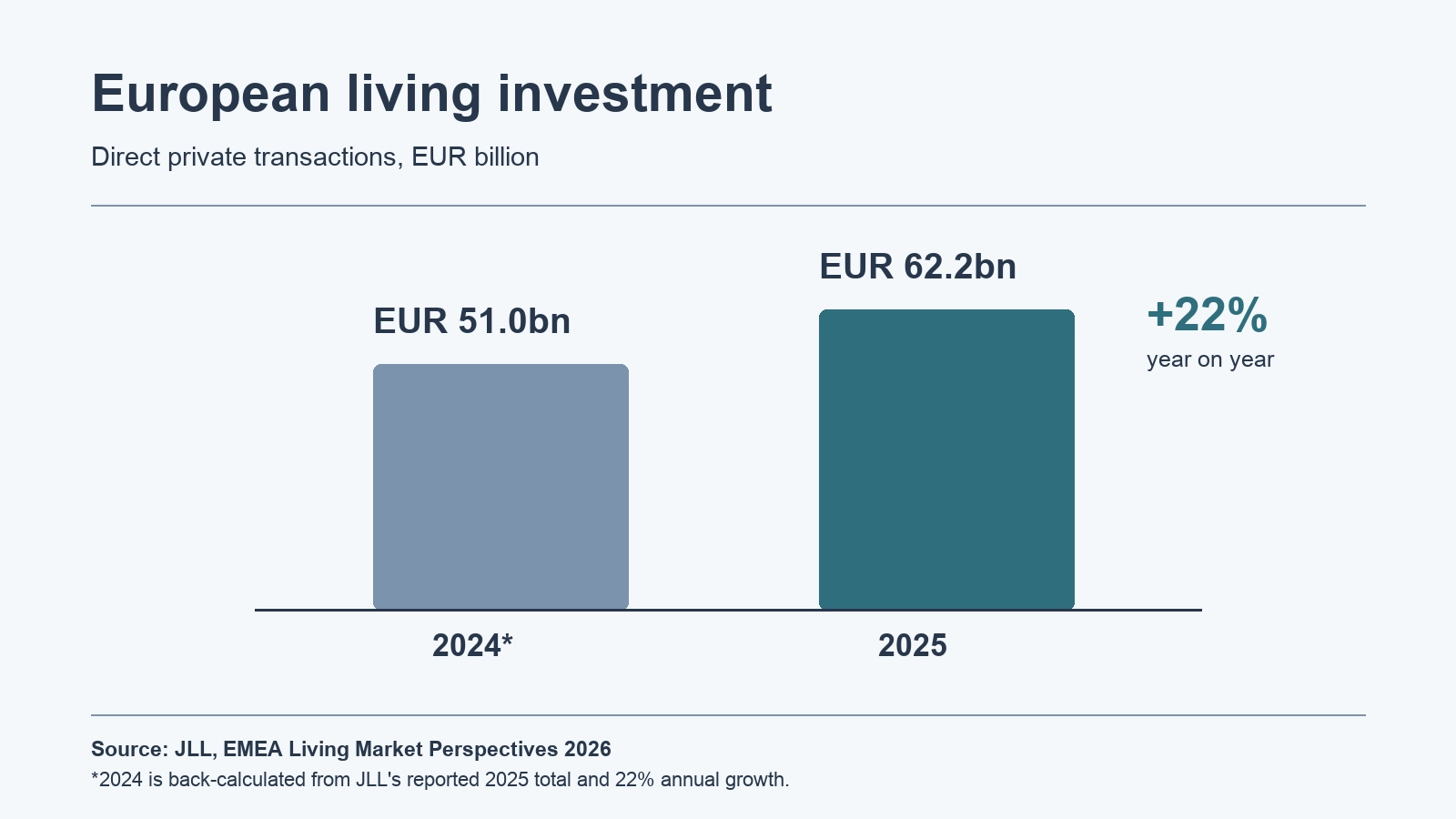
Institutional investment into Italian real estate rose 55% in 2024, to EUR 10 billion (Cushman & Wakefield, 2025). Across Europe, Living was 30% of all direct real estate investment in 2025, the largest sector for the second year running, with volumes up 22% to EUR 62.2 billion and a further 10-15% growth forecast for 2026 (JLL, 2026).
That capital is looking for operational, income-producing living product. Italy does not have enough of it standing and it cannot build its way there at the speed the money is arriving.
So the binding constraint is not equity. It is the number of buildings that can be turned into something the capital wants to own, at a price that still works.
Takeaway: When capital outruns product, the scarce skill is conversion, not sourcing.
Reason 2: The demand gap is structural and the vacant stock does not answer it.
Between 2009 and 2024 Italy added 2.1 million households but only 1.1 million homes (ISTAT, 2025).
The obvious retort is that Italy already has a large vacant housing stock. It does. It is also largely in the wrong place or the wrong condition: shrinking villages, seismic exposure, and units that fail basic energy codes.
Vacancy in the wrong location is not supply. It is a liability with a postcode.
Meanwhile, office vacancy in Milan’s CBD and central areas was below 3% as of Q3 2025 (Cushman & Wakefield, Q3 2025). That is an office-market measure, not evidence of living demand. It shows why vacant buildings cannot be treated as interchangeable supply: a conversion still needs a separate, local demand test.
Reason 3: The market is already voting with change of use, not new build.
This is the single most underread statistic in Italian real estate right now.
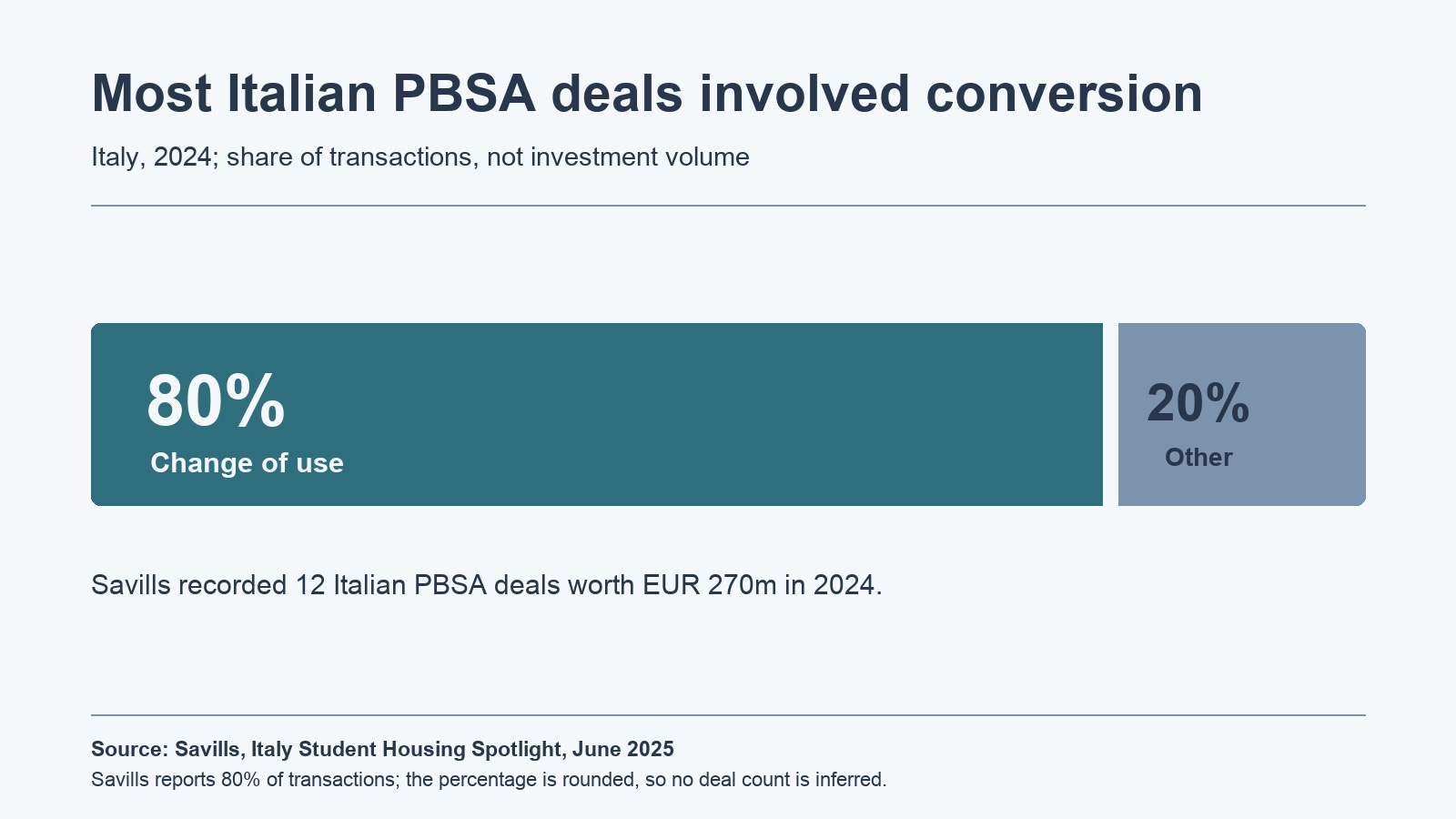
Of the record EUR 270 million invested in Italian PBSA in 2024, 80% of deals involved a change of use of existing assets, and Milan alone accounts for around a third of the national development pipeline (Savills, 2025).
Roughly four in five transactions involved existing buildings changing use. That is a share of deals, not a share of the EUR 270 million invested.
International capital is driving this. In 2025, Continental Europe overtook the UK in student housing investment for the first time, with international buyers up 55% year on year against 2% growth for domestic capital (JLL, 2026).
The pattern is not specific to student housing. It is what happens in any market where land is scarce, planning is slow and demand is concentrated in a handful of transit-served districts.
Takeaway: In Italy, the development pipeline is mostly a conversion pipeline wearing a different name.
Reason 4: The 2030 and 2033 milestones put the weakest stock on a clock.
Until recently, repositioning stranded stock was a value-add choice. It is becoming a compliance event.
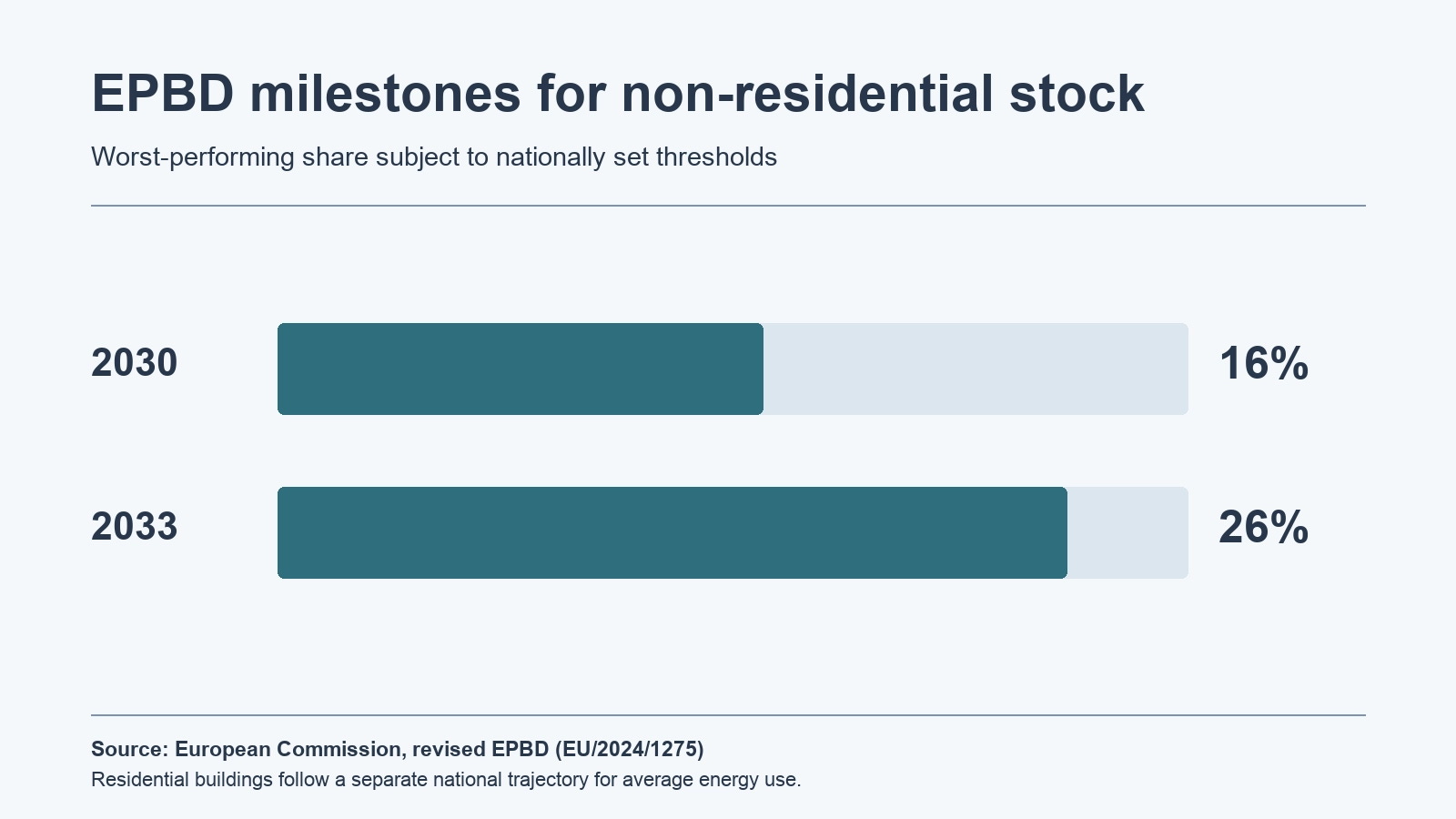
Under the recast Energy Performance of Buildings Directive, member states set minimum energy performance thresholds for non-residential buildings. The rules target the worst-performing 16% of that stock by 2030 and 26% by 2033. Residential buildings follow national trajectories for reducing average energy use, so the asset-level test depends on the building and national implementation (European Commission).
I explored the investment case for upgrading existing buildings in The Retrofit Revolution. The regulatory milestones add another reason to test the retrofit option before assuming an asset has reached the end of its economic life.
For owners, energy performance now belongs in the hold, retrofit and conversion decision. The directive does not itself require a change of use, but the work needed to comply can shift the economics of each option.
Reason 5: Convertibility is engineered, not discovered.
This is the part most screening models miss. Convertibility is not a characteristic you find in a building. It is something you design into it.
In Milan, I am working on the conversion of a standing office building to PBSA. The municipality is allowing an additional 30% of gross floor area because the proposal brings the building back into use and improves its energy performance. That planning uplift can change the investment case. It is specific to this confirmed scheme, and the additional area still has to earn its place in the underwriting after construction and operating costs.
Here the use does change, and the right proposal can attract support from the local authority as well as demand from occupiers.
Before underwriting an Italian conversion, I run five questions:
Demand: is there genuine, evidenced demand for the converted use in this specific catchment, not the national average?
Structure: do the bones work? Even floor plates, ceiling heights above 3 metres, a footprint shallow enough for natural light.
Location: is it within roughly 500 metres of transit or real amenity? Conversion does not fix a bad address.
Cost and carbon: can you target at least 30% carbon savings at under 80% of new-build cost?
Incentives: do local grants, tax credits and green financing stack, and do they survive due diligence?
Score those honestly and most stranded assets fail. That is the point. The few that pass are the deals.
And the failure mode is almost always survey risk, not market risk. I have seen a Turin retrofit collapse when asbestos remediation costs ran past the deal’s entire margin. Historic protections, rigid zoning, seismic exposure and fragmented condominium ownership do the same job more slowly.
Italy compounds this. The planning system still rests on a 1942 national law, layered with regional decrees and municipal codes, which is why asking three experts the same question can return three different answers. Regulatory fragmentation is not background noise here. It is a priced risk, and it is the reason a convertibility score has to include entitlement, not just structure.
The Bottom Line
Italy’s next cycle will not be won by picking the right sector. It will be won by owning the buildings that can move between sectors.
Stop screening by asset class first. Screen by what the building can become, then check whether that use is the one capital wants.
Model the EPBD milestones. Check whether the asset falls within the national thresholds for non-residential stock in 2030 or 2033, then price the required works and timing.
Buy the location, engineer the rest. Structure, core and efficiency are design problems. A bad address is not.
Price entitlement risk explicitly. In Italy, regional and municipal variation is a line item, not a caveat.
Run the survey before the model. Asbestos, seismic and condominium ownership kill more conversions than yields do.
Stranded stock in the right location is worth more repurposed than left as is.
That’s all for today.
— Carlo
Founder and Managing Director, Benigni | Follow me on LinkedIn
Working on a development or repositioning project?
I help investors and developers test whether a project stacks up before significant capital is committed: the market case, the cost plan, the planning route and the risks nobody has priced.
Know someone working on a similar deal? Forward them this issue.